ZERIC
Project Mission

Engineering as Sovereignty, Not Spectacle.

Zeric.tech exists at the intersection of ancient, long-duration construction wisdom, modern structural science, and the legal pathways required to certify it under United States engineering licensure.

§1 · The Archetype We Measure Against

Cyrus Harding, and why we open with him.

In Jules Verne’s The Mysterious Island (1874), a small band of castaways is led by Cyrus Harding — an engineer who, stranded on a deserted island with no factory and no supply chain, builds civilization: a brick kiln, a forge, a fired-clay house, drinking glass, gunpowder, an aquifer, a windmill-driven dynamo, and a long-distance telegraph. Every load-bearing component is fabricated from raw island materials; every design decision is justified by principles he carries in his head.

We open with Harding because he is the fictional proof that any intelligent practitioner, working with local materials and sound engineering principles, can build infrastructure that lasts longer than the culture that built it. Sovereign Engineering is the formalization of that capability for the 21st century — backed by modern materials science, modern load-path analysis, and modern licensure pathways.

In one sentence

“He could build anything, from memory, using only what the land provided.”

— Jules Verne, 1874

§2 · Why Sovereign Engineering, and Why Now

The 30-year replacement economy is a choice, not a law.

Roman pozzolanic concrete has survived two thousand years of seawater submersion. The piers of Cosa, the breakwaters of Caesarea, the Pantheon dome — all still standing, all using a chemistry Rome patented in the first century BCE. Modern Portland cement, by contrast, begins degrading inside thirty years and is structurally compromised inside eighty.

The reasons for that gap are not technical. They are economic. Modern procurement optimizes for the lowest first-cost bid and the shortest capital recovery window — which means structures designed to be replaced, not structures designed to endure. That is a defensible business decision. It is a catastrophic engineering decision.

Sovereign Engineering rejects that framing. It accepts the higher first cost of long-life materials in exchange for the elimination of rebuild cycles, the reduction of embodied carbon across centuries, and the resilience of communities that can repair their own infrastructure with local labor and local materials.

And critically — these methods are not illegal. They are performance-based, permitted under the alternative-materials provisions of the International Building Code when signed by a state-registered Structural Engineer (SE). The licensing is the bottleneck. That is what the Zeric.tech portal exists to fix.

§3 · Core Principles

Four commitments that distinguish Sovereign from common engineering.

Principle 01

Longevity Over ROI

Modern civil engineering is optimized for short-cycle profit — structures rated for 30 to 50 years when the chemistry of the materials could give us two millennia. Sovereign Engineering designs for centuries. The cost amortizes differently when your great-grandchildren inherit a working cistern, not a demolition contract.
Principle 02

Alternative Construction, Proven

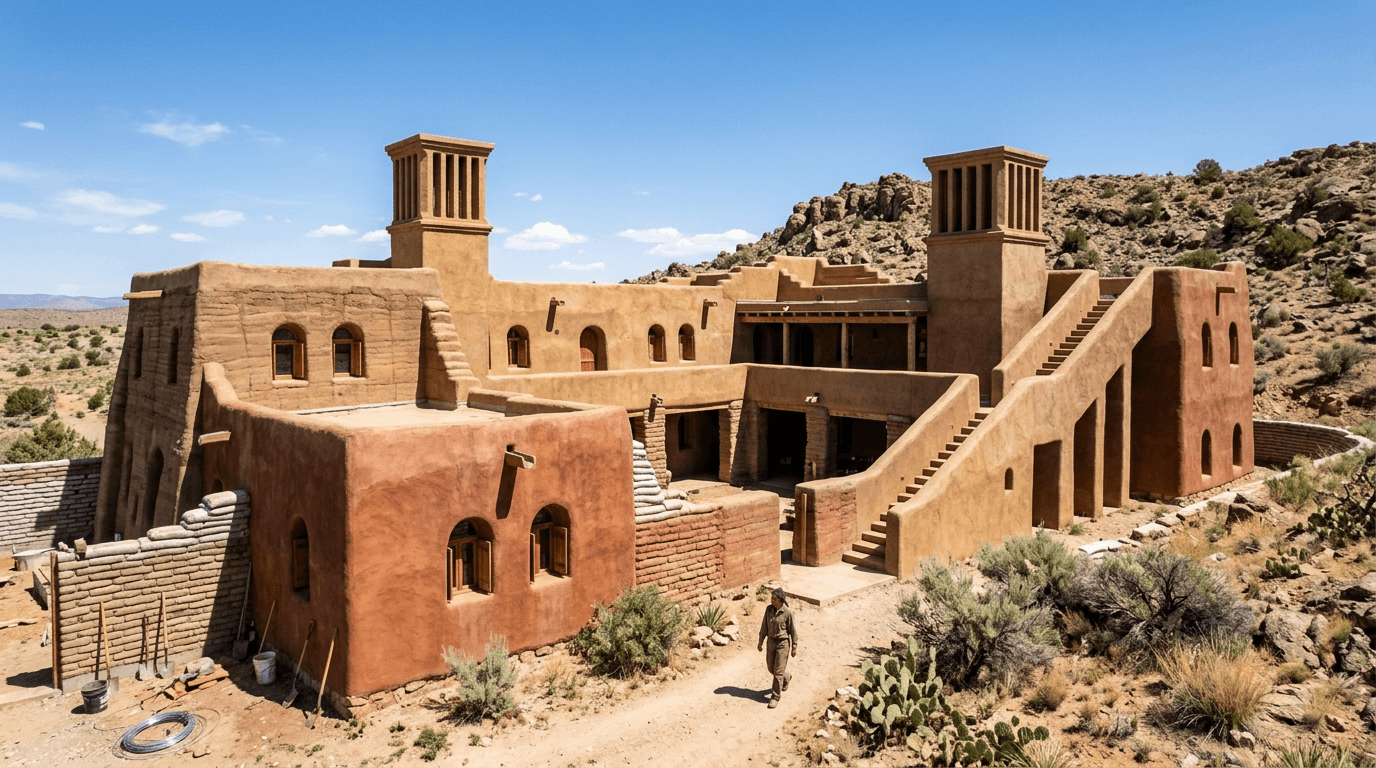
Roman pozzolanic concrete, Persian qanat hydraulics, modular timber joinery, and high-thermal-mass masonry all survive modern peer-reviewed scrutiny. We are not inventing new materials — we are re-certifying the ones the ancients used, with Load and Resistance Factor Design (LRFD), unit modernization, and engineering synthesis on top.

Principle 03

Technological Synergy

Ancient wisdom meets frontier tooling. Pozzolanic chemistry is now provable in a materials lab. Adobe geometry is now extrudable on a 3D concrete printer. Modular joinery is now camera-perfect with photogrammetry. The studio equivalent of Cyrus’s windmill is a K8s-hosted Blender MCP server — but the engineering principles are his.

Principle 04

Economic Sovereignty

Communities resilient without constant reinvestment. When roads, bridges, and houses are designed to be repaired by neighbors with local materials (clay, lime, sand, stone, straw), the cost of failure drops to near zero. This is the VFW / Amish partnership model — mutual aid, not state dependency.

§4 · Differentiation

How Sovereign Engineering differs from common construction practice.

The table below is the rationalist’s case. It is not a polemic — each row maps to a verifiable engineering metric.

DimensionCommon EngineeringSovereign Engineering
Design lifespan30–50 years (planned replacement)Centuries (designed for inheritance)
Code pathPrescriptive — exact mix, exact rebarPerformance-based — engineer-signed, AHJ-approved
MaterialsIndustrial: Portland cement, kiln-fired brickLocal: lime, clay, pozzolana, stone, straw, sand
Skill floorEngineers and licensed trades onlyCommunity-buildable with engineering training
Embodied carbon / centuryHigh (multiple rebuilds)Low (single long-life build)
RepairabilitySpecialist replacementLocal materials + vernacular techniques

§5 · Achievability

Why anyone can do this.

Sun-dried adobe masonry wall — materials any community can source
Field Plate · Achievability
Adobe: clay, sand, straw, water. Available on every inhabited continent.

The materials are local and abundant.

Every inhabited continent has clay-bearing soil, sand deposits, lime-bearing rock, and plant fiber. The Roman pozzolanic mix is volcanic ash + lime + seawater. The Persian qanat is hand-excavated alluvial clay. Adobe is sun-dried earth + straw. Historically, sovereign-built communities sourced within a day’s walk of the project, at zero transportation cost.

The skills are teachable, not licensed.

Cob, adobe, rammed earth, stone masonry, and timber joinery are techniques — not credentialed professions. Workers learn them in weeks. The supervision overhead is low because the geometry and proportions are forgiving, and the failure modes (settlement, cracking, weathering) are visible during construction, not hidden behind cladding.

The math is high-school level.

Vitruvius’s modular proportions are ratios. Load paths in arches are geometry. Material strength estimates for soil-cement mixes use arithmetic and unit conversion. The Phase 0 curriculum — Algebra, Geometry, Trigonometry, Pre-Calculus — is the entire math floor. Calculus is for advanced failure-mode analysis, not for routine construction.

The toolkit is simple — and getting simpler.

Shovel, trowel, level, plumb bob, hand-mixer. Cyrus Harding’s entire fabrication toolkit on The Mysterious Island was hand-built from the wreck. The 21st-century equivalent equips the same practitioner with a 3D-printable geopolymer extruder — but the engineering principles and the materials are unchanged.

§6 · Sovereign Sources — The Bibliography

Primary texts and modern references.

Our “Commented Edition” strategy: every ancient text below is anchored to a public-domain base translation, then layered with Modern Engineering Commentary, Unit Modernization (quinaria, cubits, talents → SI / Imperial), and Scientific Proofs linking to LRFD, geopolymer chemistry, and matrix analysis. Modern references are open-source to keep the path financially accessible.

Sovereign Sources (Ancient & Historical)

AuthorWorkBase TranslationFocus
VitruviusDe ArchitecturaMorris Hicky Morgan (1914)Modular proportions, pozzolanic concrete, site selection
FrontinusDe aquaeductuClemens Herschel (1899)Hydraulic standardization, the quinaria system
NewtonPrincipiaAndrew Motte (1846)Foundations of natural philosophy & laws of motion
Da VinciNotebooksJean Paul Richter (1883)Fluid dynamics, structural mechanics, the arch
RankineApplied MechanicsOriginal English (1858)First rigorous physics-to-structural-engineering bridge
TrautwinePocket-BookOriginal English (1872)Gravity dams, retaining walls, high safety factors
Li JieYingzao FashiManual translation requiredModular carpentry and masonry specifications (1103 AD)

Modern References (Open Source)

SourceOriginScope
OpenStaxRice University open textbooksMath, Physics, Chemistry
NCEES FE Reference HandbookFundamentals of EngineeringProfessional standard, free PDF
Paul's Online Math NotesPaul Dawkins (Lamar University)Engineering-specific calculus & differential equations

We certify, not romanticize.

The Sovereign Engineering mission is not a nostalgia project. We do not publish ancient recipes for their aesthetic charm. We publish them because, in 2026, on a planet facing climate volatility, infrastructure decay cycles, and supply-chain fragility, they remain the most rigorously defensible construction methods humans have ever produced.

Every page on this site, every translation, every process guide, every syllabus lesson is open-source under the MIT License so that the knowledge persists even if the domain does not. The licenses required to certify these methods exist; the bottleneck is preparation, not regulation. The portal is where we close that gap.